
Our 6-7 team spent a couple of days in the science lab analyzing soil to determine whether or not it was capable of growing plants for our Global Food Chain unit this marking period. See for yourselves what they discovered!
Showing posts with label biotechnology. Show all posts
Showing posts with label biotechnology. Show all posts
Wednesday, November 18, 2009

Crime Scene Investigators
Our 7th grade classes participated in a crime scene investigation project for their Unit 1 assessments. An actual crime scene was created in the school for students to analyze and compile data. They were to take their analysis and investigative work to decide who committed the crime and compile the evidence together. Take a look at some of their work!
Visit to the Dairy Farm
Our 6th grade classes visited, VDS Farms, LLC, a local dairy farm to start off their Unit 2 stories for their ELA classes. Students were given a list of questions to ask the farmer who conducted the tour and also took notes along the way. They had quite an experience!
Tuesday, March 31, 2009
6th Grade Biotechnology Unit 4 Presentations
Students on our 6th grade team researched a disease and predicted its impact on the population in Science. In Social Studies, they researched a particular region of Mexico and its interdependence with the United States. In Math, they correlated data from their research into a pie graph. In English, they wrote a story that tied both their Science and Social Studies research together. They presented all of their information together to a group of their peers recently.
Monday, January 19, 2009
WGOM: Check in on the Salmon!
Have you checked in on the salmon lately?
We're happy to be back in action again on The Lancer Letter and bring you more updates in the coming weeks.
We're happy to be back in action again on The Lancer Letter and bring you more updates in the coming weeks.
Wednesday, December 17, 2008
Q&A: Biotechnology Across the Core Curriculum

Ms. Cook's 7th grade English class recently sent persuasive letters out to local stores urging managers to invest in Fair Trade coffee. Preparation included watching the powerful documentary, Black Gold, which was filmed in Ethiopia. It showed the plight of coffee farmers fighting to get a fair price for their crops.
Planning for the letter included a Persuasion Map Planning Sheet where students developed a thesis statement, main reasons to support their claim, and examples to validate the argument.
Black Gold:
Wednesday, December 10, 2008
Q&A: More about Global Food Chain
7th Grade Science Classes raise salmon from egg to release!

See where they are at on their project as of this week and stay tuned for further updates!
Why salmon in the classroom?
In our state, we face many challenges in the management of our Great Lakes fishery. Salmon in the Classroom can be a great educational tool and some Michigan educators have participated for many years. Yet, the ecology of the Great Lakes is changing at an astounding rate. We all remember when water pollution was on the news every day. Today, a new pollution, biological pollution, may prove to be our greatest challenge.
- Excerpt from Salmon in the Classroom Introduction, MDNR Publication
Students will continually monitor, care for, and maintain the salmon's environment. When the salmon are big enough, they will be released into the wild and will help contribute to the food chain, which ultimately ties in with our Unit 2 Curriculum this school year.
Monday, November 24, 2008
WGOM: Field Trips for 6th and 8th Graders
Our sixth graders recently took a trip to a dairy farm to see what life is like for the farmers and the cows. They were able to ask questions and tour each area of the farm. Each group, over the Wednesday and Thursday, were able to witness the birth of at least one calf, as well as the milking room, and each area where different groups of cows or calves are housed. Students gained a lot of knowledge of the current unit of our biotechnology curriculum (Global Food Chain) as well as an understanding of the work that goes into running a farming business.
Ms. Kidman and her eighth grade Spanish class also took a day trip to Chicago. While there, they were able to receive a lesson in salsa dancing, visit a pastry and candy store, and tour the National Museum of Mexican Art.
Ms. Kidman and her eighth grade Spanish class also took a day trip to Chicago. While there, they were able to receive a lesson in salsa dancing, visit a pastry and candy store, and tour the National Museum of Mexican Art.
Wednesday, November 19, 2008
Q&A: Uglies in the Curriculum
How has The Uglies helped to reinforce the biotechnology curriculum?
Mr. Koch's 7th Grade Science class completed their final project for Unit 1: Technological Innovations by designing several of the technologies available to the characters in The Uglies by Scott Westerfeld. Students were graded on several different aspects of the project, including the amount of detail, the quality, the color, and the labels they used in order to describe their technology and how it worked. Please be sure to check out the sample of projects!
This is a list of items and the page numbers where they were described in the book:
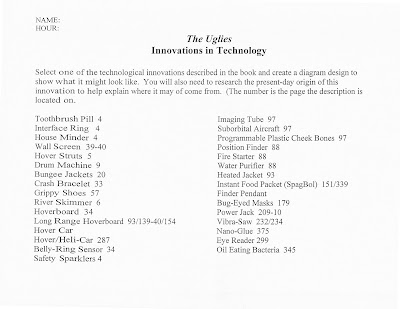
Mr. Koch's 7th Grade Science class completed their final project for Unit 1: Technological Innovations by designing several of the technologies available to the characters in The Uglies by Scott Westerfeld. Students were graded on several different aspects of the project, including the amount of detail, the quality, the color, and the labels they used in order to describe their technology and how it worked. Please be sure to check out the sample of projects!
This is a list of items and the page numbers where they were described in the book:
Wednesday, November 5, 2008
Q&A: Unit 1 of Biotechnology Curriculum, Technological Innovations
Unit 1 of the Biotechnology Curriculum at Milwood Magnet School focuses on Technological Innovations. Each core area has essential questions to help guide lesson plans to focus on curriculum content.
Questions for Unit 1 include:
Grade 6
Math: How do technological innovations affect the efficient use of our resources?
Social Studies: How do we understand our place in the world?
ELA: How does our changing world affect your life?
Science: How does research and technology improve society?
Grade 7
Math: How have technological innovations affected the society in which you live?
Social Studies: How do we understand other cultures' place in the world?
ELA: How does interacting with others help construct meaning and promote innovation?
Science: How does research and technology improve our quality of life?
Grade 8
Math: How has technology changed the movement of people?
Social Studies: How do we understand our country's place in the world?
ELA: How do interactions with others help you contribute to society?
Science: How does research and technology improve our understanding of the world?
Students complete assignments and projects based on the curriculum. One example is in seventh grade science, students experimented with calcium chloride (CaCl) to see if it could have been what was used to heat "Spagbol" in The Uglies by Scott Westerfeld, which Milwood Magnet is using as the all-school read this school year to reinforce the Biotechnology theme. Students used different amounts in water (H2O) and measured the temperature change. Their response: "The more chemical we added, the hotter the water got. So it could have been used to heat the 'Spagbol'."
As we begin to wrap up the first unit, more completed projects will be featured from Unit 1.
Questions for Unit 1 include:
Grade 6
Math: How do technological innovations affect the efficient use of our resources?
Social Studies: How do we understand our place in the world?
ELA: How does our changing world affect your life?
Science: How does research and technology improve society?
Grade 7
Math: How have technological innovations affected the society in which you live?
Social Studies: How do we understand other cultures' place in the world?
ELA: How does interacting with others help construct meaning and promote innovation?
Science: How does research and technology improve our quality of life?
Grade 8
Math: How has technology changed the movement of people?
Social Studies: How do we understand our country's place in the world?
ELA: How do interactions with others help you contribute to society?
Science: How does research and technology improve our understanding of the world?
Students complete assignments and projects based on the curriculum. One example is in seventh grade science, students experimented with calcium chloride (CaCl) to see if it could have been what was used to heat "Spagbol" in The Uglies by Scott Westerfeld, which Milwood Magnet is using as the all-school read this school year to reinforce the Biotechnology theme. Students used different amounts in water (H2O) and measured the temperature change. Their response: "The more chemical we added, the hotter the water got. So it could have been used to heat the 'Spagbol'."
As we begin to wrap up the first unit, more completed projects will be featured from Unit 1.
Wednesday, October 29, 2008
Q&A: What is a Magnet School? The Kalamazoo Promise? What about Biotechnology?
Every Wednesday we will try to answer some of the most frequently asked questions about Milwood and Kalamazoo Public Schools in detail. This week, we will focus on the three most important questions that encompass the Milwood Magnet experience for those who are interested in knowing more about the school.
What is a Magnet School and what are the advantages of sending my student to a magnet school?
A magnet school is a school which offers specialized curriculum and offers a school of choice for the district in which it resides. Historically, magnet schools began as a way for the government to aide in the desegregation of school districts. Today, magnet schools provide students an opportunity to succeed academically while learning in a diverse environment.
Your student would benefit in attending a magnet school for many reasons, including improved academic achievement, diversity in enrollment, higher attendance rates, higher graduation rates, and lower drop-out rates. Magnet schools obtain a higher level of parental involvement, more personalization through theme-based education, and specialized programs that provide a safer environment for learning. Teachers are better prepared to teach students through a focused curriculum and are more developed professionally than in a traditional school.
What is the Kalamazoo Promise?
The Kalamazoo Promise is a pledge by a group of anonymous doners to pay up to 100 percent of tuition at 4-year college programs for any high school graduates of Kalamazoo Public Schools. In order to qualify, students must be a student within the Kalamazoo Public Schools district lines and have attended a Kalamazoo Public Schools school from at least the 9th grade. Students who enroll at Milwood Magnet School in the 6th grade, not having previously attended a Kalamazoo Public School, are eligible to receive 80 percent of their tuition expenses covered by the Promise when they graduate from a Kalamazoo Public Schools high school. For more information, visit http://www.kalamazoopromise.com/.
What is Biotechnology and why is it the focus of curriculum at Milwood Magnet School?
Biotechnology is technology based on biology, especially when used in agriculture, food science and medicine. It encompasses everything from genetic engineering to alternative fuels and many other avenues of science. Milwood Magnet School chose this theme because of the emerging biotechnology-based companies emerging in the southwest-Michigan region, who Milwood Magnet School is currently working with to develop a relationship with as a Biotechnology Partner.
The Biotechnology Curriculum is taught in six different units that include biofuel energy, environmental protection, global foodchain, medical technology, sustainable industries, and technological innovations. Milwood Magnet School is trying to further the understanding of the theme through an all-school read of The Uglies by Scott Westerfield.
Here are a few examples of how well our students are embracing the understanding of Biotechnology in our world and in our school:
What is a Magnet School and what are the advantages of sending my student to a magnet school?
A magnet school is a school which offers specialized curriculum and offers a school of choice for the district in which it resides. Historically, magnet schools began as a way for the government to aide in the desegregation of school districts. Today, magnet schools provide students an opportunity to succeed academically while learning in a diverse environment.
Your student would benefit in attending a magnet school for many reasons, including improved academic achievement, diversity in enrollment, higher attendance rates, higher graduation rates, and lower drop-out rates. Magnet schools obtain a higher level of parental involvement, more personalization through theme-based education, and specialized programs that provide a safer environment for learning. Teachers are better prepared to teach students through a focused curriculum and are more developed professionally than in a traditional school.
What is the Kalamazoo Promise?
The Kalamazoo Promise is a pledge by a group of anonymous doners to pay up to 100 percent of tuition at 4-year college programs for any high school graduates of Kalamazoo Public Schools. In order to qualify, students must be a student within the Kalamazoo Public Schools district lines and have attended a Kalamazoo Public Schools school from at least the 9th grade. Students who enroll at Milwood Magnet School in the 6th grade, not having previously attended a Kalamazoo Public School, are eligible to receive 80 percent of their tuition expenses covered by the Promise when they graduate from a Kalamazoo Public Schools high school. For more information, visit http://www.kalamazoopromise.com/.
What is Biotechnology and why is it the focus of curriculum at Milwood Magnet School?
Biotechnology is technology based on biology, especially when used in agriculture, food science and medicine. It encompasses everything from genetic engineering to alternative fuels and many other avenues of science. Milwood Magnet School chose this theme because of the emerging biotechnology-based companies emerging in the southwest-Michigan region, who Milwood Magnet School is currently working with to develop a relationship with as a Biotechnology Partner.
The Biotechnology Curriculum is taught in six different units that include biofuel energy, environmental protection, global foodchain, medical technology, sustainable industries, and technological innovations. Milwood Magnet School is trying to further the understanding of the theme through an all-school read of The Uglies by Scott Westerfield.
Here are a few examples of how well our students are embracing the understanding of Biotechnology in our world and in our school:
Subscribe to:
Posts (Atom)
